- Diaspora
- No Comment
Zimbabweans face 5-year re-entry ban following SA repatriation


By Agencies
SOUTH AFRICA: Foreign nationals who voluntarily agreed to be repatriated from Cape Town to the Beitbridge border have expressed dismay after learning they would be declared undesirable and barred from re-entering South Africa for up to five years.
Since Sunday, the Department of Home Affairs office in Epping has served as the processing centre for hundreds of Zimbabwean nationals who fled from various parts of the Western Cape amid fears of violence ahead of Tuesday’s planned nationwide anti-immigration protests.
The voluntary departures come despite repeated assurances from President Cyril Ramaphosa and Acting Police Minister Firoz Cachalia that while peaceful protest is protected under the Constitution, intimidation, vigilantism and attacks on foreign nationals would not be tolerated.
The City has activated area-based Joint Operations Centres. Operations Tuesday will be coordinated by the Disaster Coordinating Team (DCT) in Goodwood.
Key priorities include preventing violence and ensuring visible and coordinated response to any incident of intimidation, looting or violence.
On Sunday, three buses transported 231 people from Cape Town to Limpopo for onward processing and repatriation.
Chrispen Bhebhe, 33, who spent Sunday night sleeping outside the Home Affairs office with his wife, said he had hoped to return to South Africa after visiting Zimbabwe but was shocked to learn he would face a lengthy re-entry ban.
“I am told they are now banning us for five years, so I do not know how we will come back. There is nothing waiting for us in Zimbabwe. I left because I could not get a job,” he said.
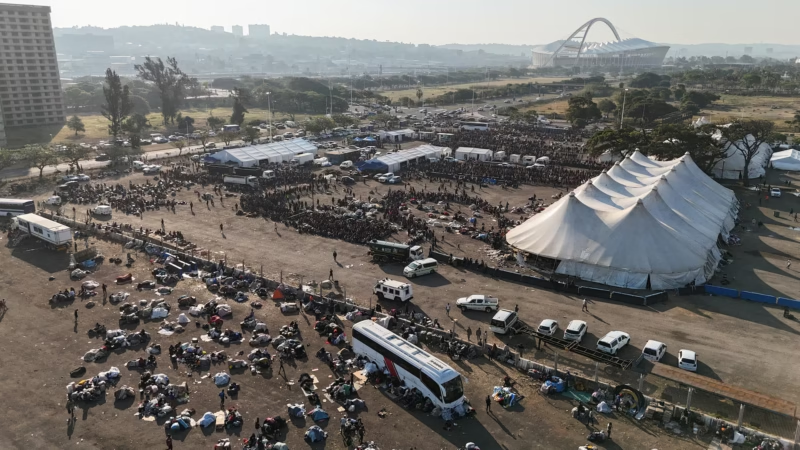
Bhebhe arrived in Epping from Robertson on Tuesday, where he had been working as a farm labourer for the past five months.
“Before that I worked on a farm in Limpopo. I arrived in South Africa in 2015. I was building a house in Robertson and sending money home to support my child, who lives with her grandmother. But we had to leave because we feared for our lives.
“Everywhere people were telling us to go home and they even went to the farm where we were working,” he said.
Gibson Nyamukwengu, 43, who worked as a bus driver in Worcester for seven years, said he also hoped to return to South Africa.
“I have all my papers and my documents are up to date. I am here because it does not matter to these people whether you are documented or not. I knew these guys were going to beat you regardless,” he said.
Nyamukwengu said he had been unable to work for the past three months after suffering a stroke.
“I was in hospital for two months and I am supposed to return in September for my medication, but I do not know what I am going to do now.
“Here I am not being helped. I slept outside in the courtyard with women and children and got soaked by the rain. There was no humanity.”
The City, working with the Department of Home Affairs, has relocated Zimbabwean nationals who had been camped outside the Zimbabwean Consulate in District Six since last week to the Epping processing centre.
Department of Home Affairs spokesperson Luthando Mavuso said the period for which a person is declared undesirable depends on how long they have been in the country illegally.
“All we can do as Home Affairs is declare people undesirable. It is the responsibility of consulates and embassies to issue them with travel documents,” he said.
Mavuso said the department had asked foreign missions to direct citizens seeking voluntary repatriation to the temporary repatriation centre in Musina.
“Across the country we have to process people who wish to leave. Part of that process is ensuring that once a person is instructed to leave, we escort them and ensure they cross the border.
“It is the responsibility of the consulates to arrange transport for their citizens to the processing centre before departure.”