- Opinion
- No Comment
Chasing Freedom — Oxford academic Simukai Chigudu on the trail of Rhodes and Mugabe

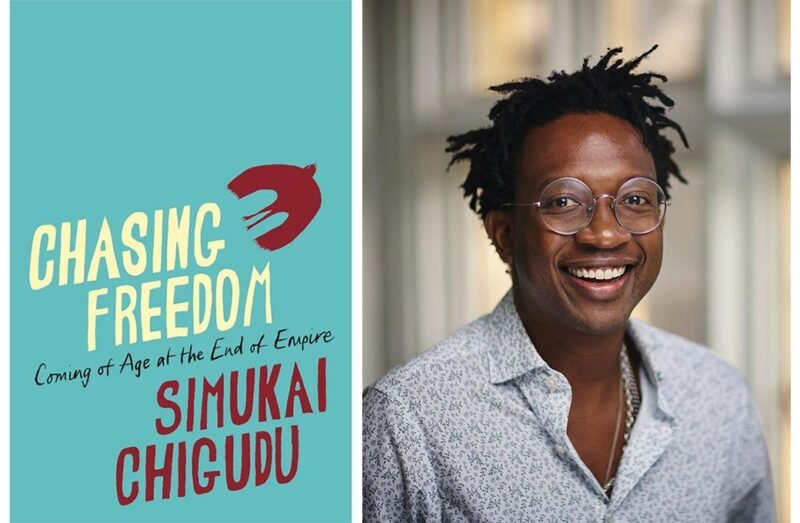
By David Piling – The Financial Times
Zimbabwean academic’s coming-of-age memoir turns a personal odyssey into a political reckoning of a nation’s cruel history and current agonies
Though Chasing Freedom is a work of non-fiction, there is something of JD Salinger’s Holden Caulfield in its author Simukai Chigudu. Like the teenage protagonist of The Catcher in the Rye, Chigudu processes adult trauma — in his case the colonial violence and postcolonial disappointments of Zimbabwe — through an almost existential angst.
The narrative follows the boy-becoming-man as he lurches in his quest for educational perfection from crisis to near mental breakdown and ultimately a kind of understanding, both of himself and of the world.
Chigudu’s odyssey is both personal and political, though that distinction necessarily blurs when he’s filtering the colonial experiences of his forebears. His grandfather was murdered by the white regime born of Cecil Rhodes’s land-grabbing enterprise and the establishment of a segregated Rhodesia.
His father, a student protester and later guerrilla fighter, was forced to drink toilet water in prison and to strip naked for sadistic guards. His Ugandan mother, meanwhile, was fighting her own battles, dealing not only with the legacies of colonialism but with the patriarchy of her own family.
Chigudu himself, born in 1986, six years after Zimbabwe jettisoned white minority rule, is a so-called “bornfree”. But he doesn’t feel free, either of his parents’ overbearing expectations — he is an only child — or of the shocking racism he encounters daily.

Associate Professor of African Politics
Nor can he shake a growing realisation about the failings and brutalities of Robert Mugabe’s “regime” (his father hates the word) as it tightens its grip on his beloved country. As Chigudu puts it: “We were the children of the oppressed coming of age in what was supposed to be a better world and now feeling disillusioned with what we’d found there.”
That makes this memoir-cum-coming-to-terms-with-history a rough Zimbabwean equivalent of Jung Chang’s Wild Swans (about China) and Lea Ypi’s Free (about Albania). But fashioned in the crucible of the Rhodes Must Fall movement in which Oxford university students, co-led by Chigudu, seek to pull down Rhodes’s statue outside Oriel College and “decolonise” the curriculum, it is also an attempt to give flesh to the feelings that produced that moment in history.
As he puts it, “I wanted to tell a more complicated story, both epic and intimate, about colonialism and its aftermath in my family.” Leavened with self-deprecation and doubt, the book manages to steer clear of pomposity or self-righteousness.
There can be a masturbatory quality to memoir, but Chigudu almost always avoids the self-indulgent to skilfully fuse his own story with the broader sweep of history.
The book’s strongest quality is its scepticism for any settled view of the world. “Ism, ism, ism, ism, until we sounded like buzzing flies” he writes at one point. The most painful rupture is with his father (both distant and revered) who has stuck to the idea, forged in his own anti-colonial struggle, that the ruling Zanu-PF party can do little wrong.
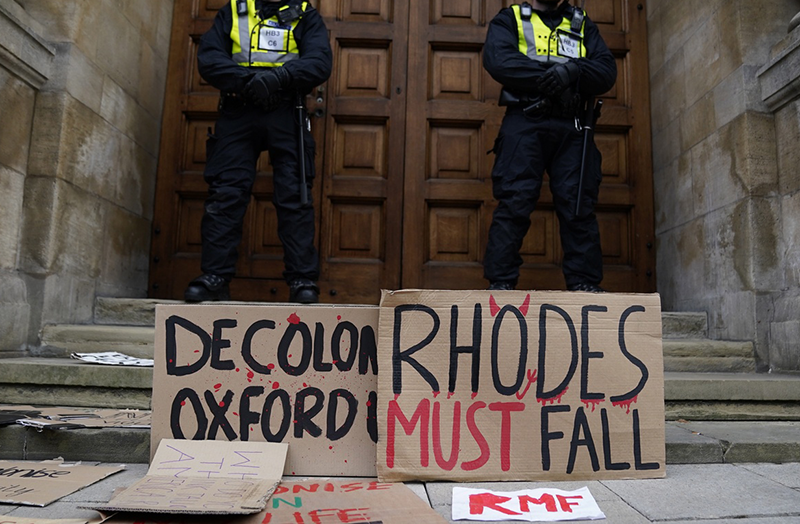
Along the way to Rhodes Must Fall, Chigudu tries God, vegetarianism, public health and psychotherapy. At the end, we suspect his intellectual and emotional quest is not over. The writing is a pleasure. A teacher’s voice is “more polished than fine leather” and hyperinflation turns Zimbabwe into a “nation of starving billionaires”.
There is much pith. “I was scarcely five years old and already collecting rejection letters.” And bursts of revelation: “It took nearly three decades before I realised that one of the reasons we kept cycling through cars was that my father kept crashing them when he was drunk-driving.”
No single truth is definitive, though the hunt for it is what gives life meaning. The book’s awakening is universal, the discovery that our parents are not infallible. The political conclusion, trite if you say it out loud, is that Zimbabwe (and much of Africa) is a mess both because of its colonial inheritance and because of its own postcolonial failings. And, not either/or. Even the dedication is a Schrodinger’s cat of veracity: “To my parents for everything, despite everything.”
The duality is born of Chigudu’s upbringing. Black Zimbabweans called him “a salad”, raised as he was in Harare’s formerly white neighbourhoods, with a colonial-style education and adopted cultural habits, like eating salad.
When white Zimbabweans weren’t being explicitly racist, they called him a soutpiel, “a salt penis”, with one foot in Africa, one foot in Europe and his testicles dangling in the Mediterranean brine.
Twin existence
It is Chigudu’s twin existence that gives the book its depth. He struggles with Shona, his mother tongue, and aspires to the cultural privileges of whites while resenting the institutions, including Oxford where he is now associate professor of African politics, that embody them.
In Newcastle, where he studies to be a doctor, what sets him apart is not so much that he is Black, but that he went to boarding school. Educational achievement is everything: the glue that holds his faltering family together, the weapon to beat prejudice, and the tool to make sense of the world.
St George’s, his Zimbabwean private school, is a microcosm of the path dependence that makes it so difficult for societies and individuals to escape their histories. Prefects beat freshmen and freshmen can’t wait to become prefects so that they can mete out the same cruelty.
“We believed colonialism had shaped everything — from our institutions to our ambitions,” he writes. There is much truth in this, but it is also a disempowering belief, one that downplays Africa’s own long pre-colonial history as well as personal choices about what to remember and what to forget. It is a deterministic vortex from which Chigudu and his moving and highly readable book are valiantly struggling to escape.