- Entertainment
- No Comment
US: In Berkeley, she’s built one of the world’s largest archives of Zimbabwean Shona music


Erica Azim has spent decades studying and performing with revered Shona artists. Her Berkeley nonprofit has recorded thousands of songs and sent more than $1.6 million to Zimbabwean musicians and instrument makers.
By berkeleyside.org
“Can you explain how you fall in love?” asks Erica Azim. “In a certain way it’s an impossible question.”
Yet it’s a conundrum the Berkeley native has contemplated for half a century, every time she’s asked about her abiding passion for mbira, which is both the traditional music of the Shona people of Zimbabwe and the thumb piano-like instrument that’s the primary medium for their celebrations and ceremonies.
Azim’s commitment to supporting musicians, healers and instrument-makers in the southern African nation has turned Berkeley into an unlikely center of cultural preservation. Over the past four decades Azim has built the nonprofit she founded and runs, MBIRA, into one of the world’s foremost archives of the incantatory Shona art form, spreading awareness through recordings, in-person workshops, performances, online lessons, and the sale of thousands of mbiras built in Zimbabwe by Shona artisans. A recently deployed streaming service provides access to more than 450 hours of mbira performed by a wide spectrum of masters from around Zimbabwe.
The vast catalog includes recordings and videos, mostly made by Azim herself on trips through rural Zimbabwe, providing a welcoming portal for anyone intrigued by mbira, which is often used in summoning ancestral spirits to healing rituals. All sales proceeds are funneled back to artists, providing a lifeline in a region beset by persistent drought and corruption-driven economic decline.
“As of a year ago, we’ve sold thousands of mbiras and sent more than $1.6 million to more than 300 instrument makers and musicians,” Azim said.

Because traditional songs, scales and mbira tunings often vary village to village, there’s tremendous variation in mbira. Azim has studied and performed with many of the art form’s most revered practitioners, including Ambuya Beauler Dyoko, Fradreck and Fungai Mujuru, Irene Chigamba, Vakaranga Venharetare, Patience Chaitezvi, Renold and Caution Shonhai, and Leonard Chiyanike, most of whom she’s also presented in concerts in the U.S. and Europe. Her own approach is both deeply traditional and broadly cosmopolitan, encompassing many of the different mbira influences she’s absorbed.
“She’s as knowledgeable as anybody in the U.S, a true scholar, and I think her passion is to preserve the culture and help the people who can extend the culture and teach it to their people,” said Berkeley composer Todd Boekelheide, who produced Azim’s 1992 album Mbira Dreams and has long served on MBIRA’s board of director.
Boekelheide explained his abiding love of mbira as flowing from “its inherent power.”
“The music is spiritual,” he said, “and draws you in with apparent simplicity. It’s played with only three digits on two hands, but sounds like a symphony, like 10 people are playing because of how the notes interact. Over the eons folk music sheds anything that isn’t an authentic expression of something that’s deeply, powerfully true.”
Part of the struggle in preserving traditional mbira music is that it’s endangered at home, and not just by the devastated economy. Like in many societies, the allure of Western pop music and electric instruments captures the attention of many young people. And there’s little support for traditional arts within the government.
On her last trip back to Zimbabwe five years ago, Oakland-based dancer Julia Tsitsi Chigamba noticed that young people are increasingly blending traditional mbira with hip hop, jazz and music from church, while nonprofit organizations provide some access to instruments and instruction.
The Zimbabwe-born artistic director and choreographer of Chinyakare Ensemble, an East Bay-based Shona dance company that performs often at Ashkenaz, was a girl growing up in a highly musical family when she first met Azim, who came by her village to record her father (mbira master Tute Chigamba). Since moving to the Bay Area in 1999, those recordings help her feel connected with her family back home.
“She’s doing amazing work,” Chigamba said. “When we see those CDs, it reminds me what I was doing then. It’s powerful. She still does a lot of work with my father. When she sends payments to people it’s distributed from my father’s house, and it’s beautiful to see that. She is the mother, and I knew her before I came here.”
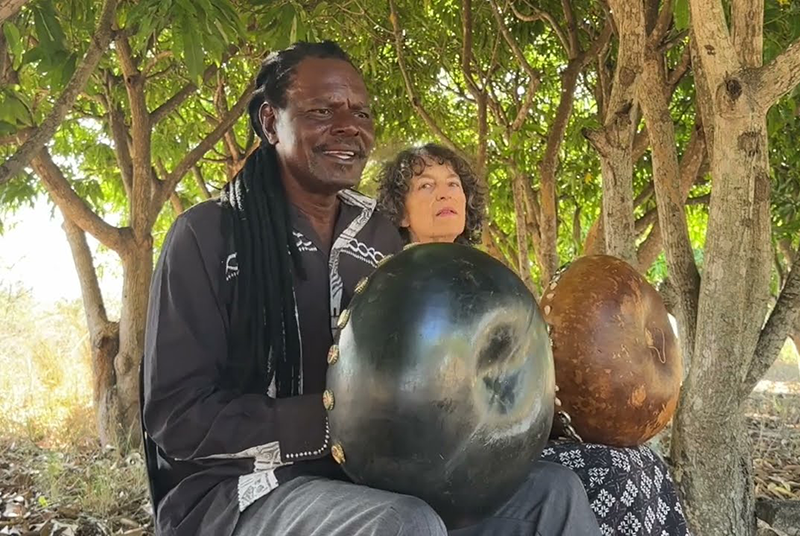
Azim first heard mbira as a teenager auditing a class at Cal
Azim was a precociously gifted student growing up in Berkeley in the late 1960s when she first heard mbira while auditing an ethnomusicology class at Cal.
Graduating in 1970 at the age of 15, she enrolled at the University of Washington to pursue her fascination with mbira, studying with Dumisani Maraire, who played a more urban rather than traditional style on the instrument. She studied at UW for two years, discovering the roots style via 45 rpm records, but eventually moved back to Berkeley to save up money for an African journey, “learning Shona from flash cards I made myself from a book out of Cal library,” she recalled.