- Politics
- No Comment
Mnangagwa removes Human Rights Commission chair; critics say move unconstitutional


By Own Correspondent and Agencies
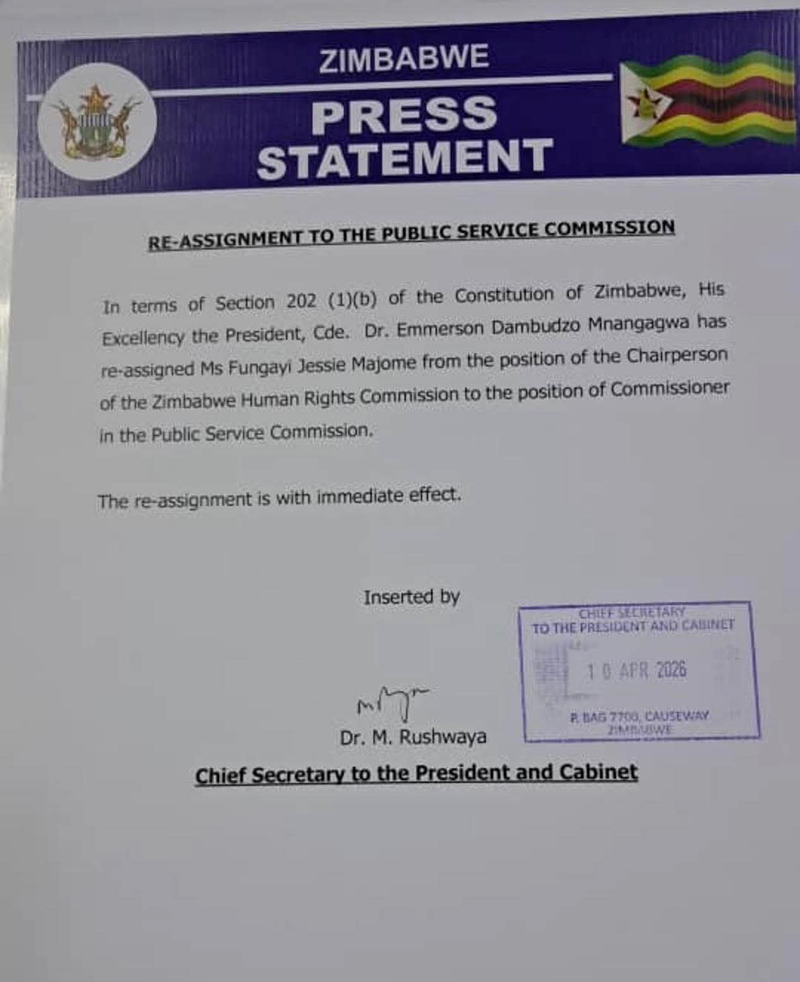
President Emmerson Mnangagwa has removed Jessie Majome as chairperson of the Zimbabwe Human Rights Commission, less than a week after she criticised public hearings on a proposed constitutional amendment.
The development was immediately slammed as uncostitutional by the analysts.
Comemented prominent lawyer, Thabani Mpofu; “A member of an Independent Commission, such as the Zimbabwe Human Rights Commission, can only be removed from office under section 237(2) of the Constitution of Zimbabwe.
“Section 237(3) expressly provides that the procedure for removing a judge also applies to members of an Independent Commission; accordingly, a tribunal must be appointed on the recommendation of the Judicial Service Commission and the member must be found guilty of misconduct before removal.
“Reassigning Jessie Majome to the Public Service Commission therefore constitutes removal from office and is unconstitutional.”
 Another legal analyst Arnold Tsunga added; “The question of how a commissioner of an independent Commission may be removed from office is covered under section 237 of the Constitution.
“It reads that a member of an independent commission may be removed from office “only on the ground”that the member is unable to perform his/her functions because of physical or mental incapacity or is grossly incompetent or is guilty of gross misconduct or has become ineligible for appointment.
“It is impirtant to note that no such allegation has been made against Chairperson Jessie Majome.”
He added, “I am lately increasingly getting concerned whether the President Mnangagwa is getting correct legal advice or not. When a president makes errors of process in important decisions, it creates public confidence and trust issues that are wholly avoidable.”
Majome’s reassignment comes after the rights commission had raised concerns over the conduct of parliamentary hearings on Constitutional Amendment Bill No. 3, which proposes extending the president’s tenure by two years, shifting election cycles from five to seven years, and introducing a parliamentary system for electing the president.
Speaking in Harare earlier in the week, she said the Commission had found that hearings were marked by limited access and intimidation, noting that while supporters of the bill were allowed to speak, dissenting voices were often shut out or harassed.
“Most of the venues were small, relative to turnout leading to large numbers of potential participants failing to enter the halls to follow or contribute to the proceedings.
“Whilst those in support of the Constitutional Amendment were able to give their views, the Commission noted the harassment and intimidation of dissenting voices. Individuals and groups opposed to CAB3 were denied audience,” Majome said.
She also indicated that the commission observed cases where participants with opposing views were threatened, denied the opportunity to contribute, or physically attacked. In some locations, access to venues was reportedly controlled, with participants screened before entry.
“There was a strong pattern of controlled participation across most provinces. Some entrances to venues were often controlled by youths, with vetting at entry points and supervised sign-in registers with restricted access. For example in Mashonaland West, men holding whips were involved in vetting participants in Mhondoro Ngezi,” Majome added.
She said such developments raised concerns about violations of constitutional rights, including freedom of expression, personal security and equality.
“Such conduct violates the rights enshrined in the Constitution including freedom of expression (section 61), freedom of conscience (section 60), right to human dignity (section 51), personal security (section 52) and equality and nondiscrimination (section 56).”
Majome, a former lawmaker and senior legal practitioner, previously served in government during the coalition administration and has been associated with the Movement for Democratic Change(MDC).
Despite earlier criticism over her appointment in 2024, she had been widely regarded as effective in her role prior to the reassignment.