- Diaspora
- No Comment
White people must leave: Former Australia captain reveals how neighbours were murdered in Zimbabwe and his family forced to flee


By The Daily Mail
AUSTRALIA: David Pocock has opened up about the terrifying violence that forced his family to abandon their farm in Zimbabwe and start a new life in Australia.
The former Wallabies captain turned independent senator was 14 when his parents moved the family to Brisbane following years of political and social turmoil.
Speaking to businessman Mark Bouris on the Straight Talk podcast, Pocock recalled losing the family farm, seeing neighbours murdered and inspecting the bullet holes left in a vehicle after a deadly ambush.
The 38-year-old said he enjoyed an ‘amazing childhood’ growing up close to nature before conditions in Zimbabwe deteriorated rapidly during the late 1990s.
‘The currency started to slide, the government became unpopular and they tried to change the constitution and they lost a referendum,’ Pocock said.
‘It was kind of this trigger where they just went into survival mode and they basically said, you know, white people and especially white farmers are the reason why Zimbabwe is not doing well.
‘And there was this sort of mass land redistribution program.’
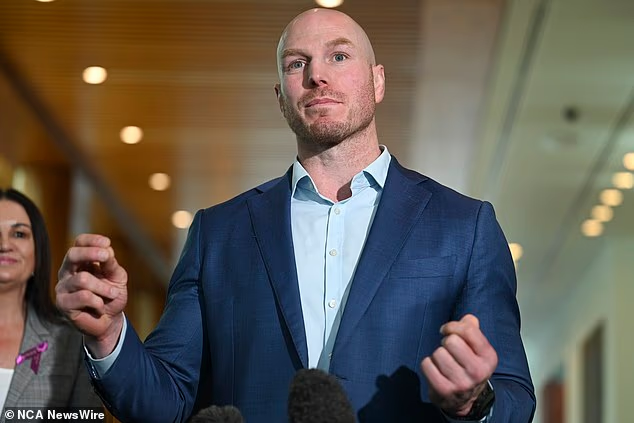
Pocock said his family had once never imagined leaving the country they considered home.
However, that changed as then-president Robert Mugabe‘s government intensified its campaign against white farmers.
‘Very quickly it went from never imagining that my family would leave Zimbabwe and feeling like this is home, this is my country, to seeing the president on TV saying, you know, white people must leave this country,’ Pocock said.
‘Thankfully my mum was a qualified teacher and we got in here on a skilled visa, but a huge few years of turmoil.’
Pocock was about 11 or 12 when conditions began to worsen and violence spread through farming communities.
‘We lost our farm. Things actually got really violent,’ he said.
‘You had politicians, you had the president really egging people on and it just got out of hand.’
Pocock then described the memory of a fatal attack near his family’s home.
‘We had a couple of neighbours murdered and I remember as a kid putting my fingers through the bullet holes in the family friend’s ute where they had been ambushed,’ he said.
‘The father and son [were] ambushed at night. The son managed to survive, the father was killed.
‘And so that was the kind of fear and anxiety.’

Pocock said his parents, who had already lived through the Rhodesian Bush War, eventually decided they could not expose their children to further danger.
‘Ultimately my folks just decided this isn’t worth staying for,’ he said.
‘We want to seek opportunity for our kids.
‘They had grown up through the Rhodesian Bush War and I think they just didn’t want any more of it and were keen to get out.’
The family chose Australia partly because its climate and culture appeared familiar.
Pocock arrived determined to make the most of the opportunity his new country had given him.
‘So I arrived here just so grateful for the opportunity after those few years in Zimbabwe and just wanting to make the most of every opportunity I got in this new country that I called home and thought had given us this sort of ticket out,’ he said.
However, he admitted the upheaval had a profound effect on his teenage years.
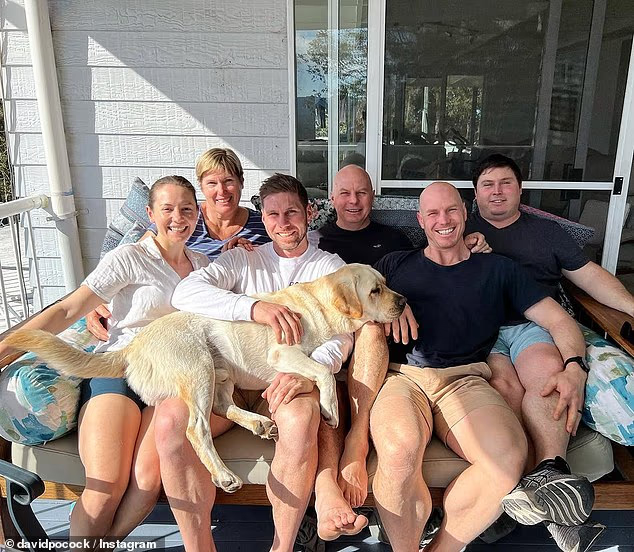
Pocock attempted to regain a sense of control by throwing himself into his education and sport, but his commitment eventually became excessive.
‘For me, it was throwing myself into sports and academics,’ he said.
‘I wanted to play for the Springboks and then after we moved to Australia, I wanted to play for the Wallabies.
‘I just threw myself into it and it became, in hindsight, like a really unhealthy obsession where things had been so out of control and now all of a sudden the things I could control were my eating and my training.
‘I became totally obsessed with training, how I ate, wanting to be the very best rugby player I could be.’
Pocock also faced a major cultural adjustment after enrolling at the Anglican Church Grammar School in Brisbane.
He said corporal punishment was still used at his Zimbabwean school and initially mistook the relaxed behaviour of Australian students for disrespect.
The teenager was also teased because of his accent, which he quickly lost. He found a sense of acceptance through sport.
‘Sport was the “in” and that was, I think, what saved me really,’ he said.
‘You can have the funniest accent, you can look different. Once you’re out on the sporting field, as long as you can contribute and have a crack, you’re part of the team.’
Pocock went on to play 78 Tests for Australia, captain the Wallabies and appear at three Rugby World Cups before entering federal politics.
He was elected as an independent senator for the ACT in 2022.