- News
- No Comment
Dubai World Government Summit: US broadcaster-turned-podcaster Tucker Carlson takes on Mnangagwa

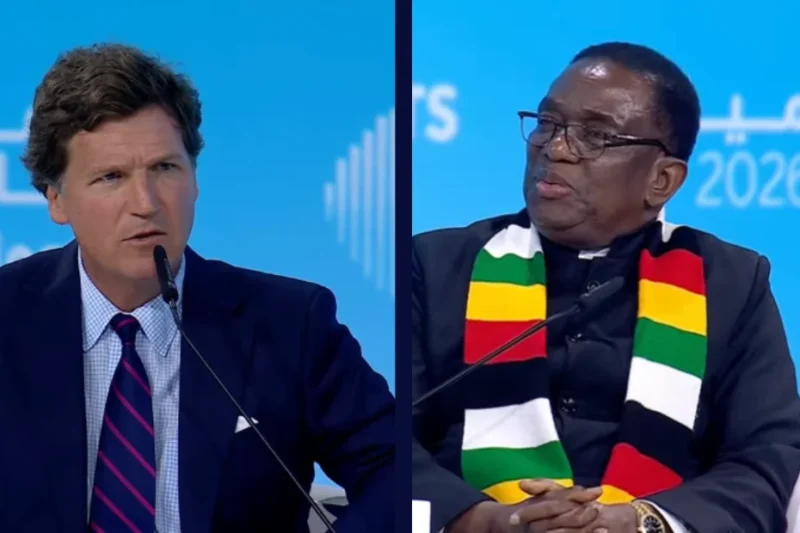
DUBAI: For many, the idea of US broadcaster-turned-podcaster Tucker Carlson and Zimbabwean President Emmerson Mnangagwa sharing a stage might once have seemed unlikely.
But that was precisely the scene on Wednesday at the World Government Summit in Dubai, where the two men engaged in a wide-ranging on-stage discussion covering China’s role in Africa, Western sanctions, land reform and economic sovereignty.
Carlson, the former Fox News host of Tucker Carlson Tonight, now runs The Tucker Carlson Show, an independent interview-led programme distributed via YouTube, X and podcast platforms. On YouTube, he has 5.6 million subscribers.
Carlson, who also interviewed the presidents of Sierra Leone and Botswana during the summit on-stage, opened by asking Mnangagwa to contrast Chinese and Western engagement on the continent.
“In as clear terms as you can, I wonder if you would contrast your experience with China versus the Western powers? Do you think that Zimbabwe and other African countries, to be totally blunt, get a better deal from Chinese investment than they have with Western powers over the last 150 years?”
Mnangagwa pointed to Zimbabwe’s post-independence trajectory and evolving partnerships.
“Well, my view is that initially as we became independent, most of our development thrust was from the West. But as we evolved, we’ve also benefitted from investment and cooperation from countries like China.”
Carlson pressed further, arguing that the underlying structure of foreign involvement had not fundamentally changed.
“But the basic structure seems the same. Foreign powers extract mineral wealth from various African countries, but do you think the arrangement that Zimbabwe and other countries currently have with China is better or worse for Zimbabwe than it was under, say the Brits.”
Mnangagwa rejected the premise of the comparison.
“I think the premises upon which you construct your question, I don’t think is perfect.”
After Carlson replied “Not surprised,” the Zimbabwean leader shifted the focus to sovereignty.
“Zimbabwe is a sovereign state, you understand. And we move on the basis that given the best results of our resources, whether it is relations with the West or the East, what is primarily important is what we as ourselves side with. We don’t need to please the West or please the East to please ourselves.”
The discussion later turned to Zimbabwe’s turbulent economic history, including land reform and long-standing Western sanctions.
“Our economy has faced challenges. Zimbabwe has been under sanctions for decades as a result of us claiming our land from the British and making ourselves independent,” Mnangagwa said. “We seized the land and gave it to our people. So sanctions were imposed on us. But in spite of all that constraint, we have developed… we feel very independent.”
Carlson questioned whether land seizures were racially motivated.
“Well, some of the land was seized from people who were born there. So I wonder if there’s a lesson about targeting people based on their skin colour, do you think.”
Mnangagwa pushed back.
“No, land did not belong to a race… when the colonialists took land from us, the time came when we asserted ourselves to take back our land. Those who wanted to have land on the same basis as the African people of Zimbabwe remained. But those who felt they were superior left.”
Zimbabwe’s economy collapsed in the early 2000s following land seizures, triggering hyperinflation, food shortages and a mass exodus of citizens to neighbouring countries. While structural challenges remain, recent data point to tentative stabilisation.
Inflation fell sharply to around 4.1 per cent in January 2026, returning to single-digit levels for the first time since the late 1990s, while GDP is estimated to have grown by about 6.6 per cent in 2025, supported by mining, agriculture and services. However, external debt, currency policy and investor confidence continue to weigh on the outlook.